
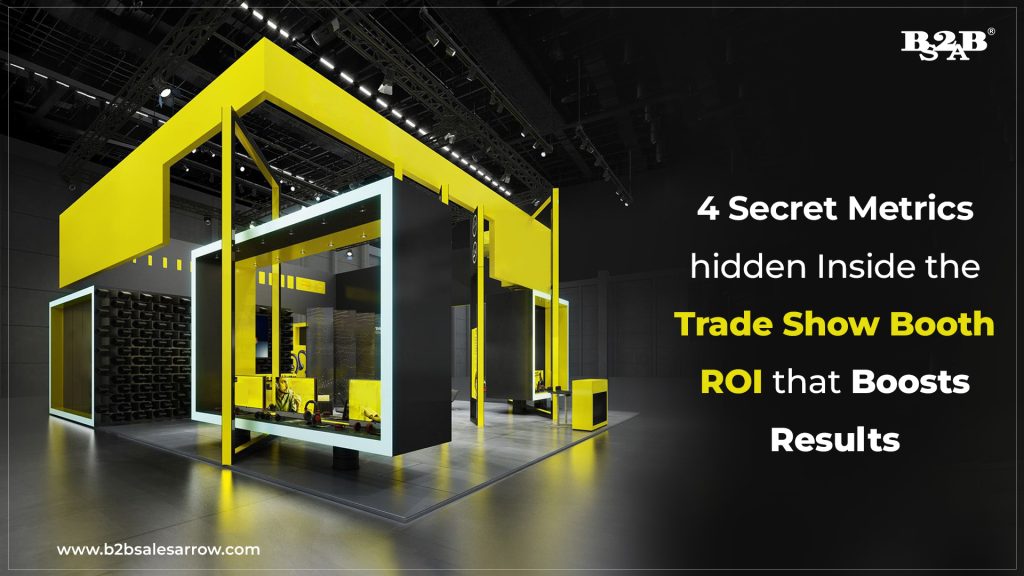
Did your last trade show investment generate tangible pipeline growth, or was the impressive booth merely a costly visual centerpiece?
C-level executives demand metrics beyond simple foot traffic and badge scans; they require genuine booth design metrics that directly connect aesthetic and functional investment to accelerate commercial performance.
Relying solely on vanity numbers fails to prove if your strategic design choices are truly translated into high-quality sales engagements. This essential blog post brings out four easy, yet powerful, executive-grade metrics hidden inside the traditional ROI equation. These indicators move past surface-level data to measure the value of qualified time, the efficiency of sales speed, navigation ease within the space, critical post-show digital actions, and the financial payback of sustainability efforts.
Top 4 Specialized, Design-Linked Event ROI Metrics
Qualified Engagement Minutes (QEM)
QEM measures the total minutes that true decisionmakers and qualified buyers spend in meaningful interactions inside your booth, rather than simply counting badge scans or raw footfall. This includes time spent in product demos, discovery conversations, solution walkthroughs, guided tours, and scheduled meetings in semiprivate zones where business discussions move deals forward.
Why is QEM Important?
- High visitor traffic without deep interaction rarely converts into real pipeline, positioning QEM as a top metric for evaluating booth design investment.
- QEM enables year-over-year and show-to-show benchmarking; for example, revealing that a smaller regional event with 40 deep, 20-minute demos actually generated more pipeline value than a major expo where hundreds of visitors only paused for 30 seconds.
- By tying engagement depth to sales outcomes, exhibition ROI calculation becomes more defensible, allowing marketers to correlate QEM with opportunities, pipeline value, and closed-won revenue.
Booth design connection
QEM is heavily influenced by how the booth is designed to guide traffic flow, stage interactions, and create spaces where focused conversations can happen without friction. Open, inviting sightlines and clear messaging pull people in quickly, while well‑placed demo stations, interactive surfaces, and semi‑private meeting pods turn passing interest into longer, higher‑value engagement minutes.
Design elements such as comfortable seating, acoustic separation for serious talks, and visible “hooks” (live demos, touchscreens, immersive content) help keep qualified visitors in the booth longer, which directly lifts QEM even if total traffic does not change.
Tools used to track QEM
| Tool Name | How It is Used? |
| Momencio | Tracks booth interactions, content views, and meeting activity to connect individual visitors with engagement duration and postshow followup outcomes. |
| iCapture | Captures lead data from badge scans and forms, adds qualification fields, and timestamp interactions so marketers can estimate qualified interaction minutes per lead. |
| Captello | Uses gamified experiences and digital touchpoints to log who engaged, what they did, and how long they participated, feeding into time-based engagement reporting. |
| Cvent LeadCapture | Standardizes badge scanning and qualification across events and timestamp each scan and note, enabling calculation of average and total qualified engagement time by persona. |
| Heat‑mapping tools (e.g., Klik smart badges, booth traffic sensors) | Monitor movement paths, dwell zones, and duration inside specific booth areas (demo zone, theater, meeting lounge) to translate physical presence into engagement minutes linked to behaviors. |
| Eventify | Provides lead capture, session tracking, and engagement analytics so exhibitors can see how long qualified attendees interact with demos, content, or staff at their booth. |
Navigation Friction Index
The Navigation Friction Index measures how easily attendees navigate through your trade show booth without confusion, bottlenecks, or dead ends. It quantifies friction points in visitor flow, such as cluttered pathways or unclear signage, using data from traffic patterns and dwell times to score booth efficiency on a scale from low (smooth) to high (problematic) friction.
This metric ranks among the top four trade show booth success indicators, alongside leads generated, dwell time, engagement rate, and conversion ratio, as it directly predicts overall booth performance.
Why is it Important?
Frustrated visitors drop off quickly, reducing dwell time and lead opportunities at your booth. Executives should view booth design not as mere décor but as a guided experience; if people cannot move seamlessly through your narrative, from entry to interaction to exit, valuable B2B connections with banks or IT firms are lost.
High navigation friction correlates with 30-50% lower engagement, making it essential for ROI justification in event marketing investments.
Booth Design Connection
Smart zoning in booth design creates a logical flow that minimizes friction, such as entry leading to a hero display, then demo zones, and finally meeting areas.
- Heat maps reveal where traffic slows, or visitors exit early, pinpointing design flaws like poor lighting or overhanging elements.
- Observation studies during setup and live events identify bottlenecks, enabling tweaks like wider aisles or directional cues.
- The booth design impact on leads is profound here, as friction-free layouts boost qualified interactions by up to 40%, turning passive browsers into engaged prospects.
Tools Used to Measure Navigation Friction Index
Exhibition booth analytics integrate Navigation Friction Index data with tools for real-time insights, helping B2B marketers optimize sustainability-focused designs like modular, low-waste booths.
| Tool Name | How It Measures Navigation Friction Index |
| Pointr | Delivers interactive maps, indoor positioning, wayfinding, and geofencing to guide attendees, flagging bottlenecks via real-time heat maps and reducing friction by 25-35% through personalized routes. |
| Mapsted | Uses advanced indoor navigation and location-based tech to draw visitors to booths, monitoring flow speeds and drop-offs to score friction and boost traffic with targeted alerts. |
| Navigine | Provides a multifunctional event app with foot traffic monitoring, mobile registration, and beacons to detect dead ends or crowds, generating friction scores from dwell anomalies. |
| Mappedin | Converts blueprints into 2D/3D maps with points of interest and exhibitor categorization, analyzing path efficiency to highlight design tweaks for smoother navigation. |
Content Activation and Share Rate
Content Activation and Share Rate tracks how many visitors engage with digital elements inside the booth, such as QR scans, AR demos, or microsites, and how often they share or revisit that content after the show.
This metric combines activation (initial interactions) with share rate (social forwards or downloads), often scored as a percentage of booth traffic that propagates content, ranking it among the top four booth design metrics for proving long-term ROI in B2B events. Companies investing in exhibit stand design in Europe increasingly prioritize interactive digital experiences to encourage visitors to scan, explore, and share branded content during exhibitions.
Similarly, brands exhibiting at large international events are integrating digital engagement tools into their trade show booth design in Las Vegas to maximize visitor interaction and extend booth visibility through social sharing and post-event content downloads.
Why It Matters?
This metric extends booth impact beyond the event floor, turning one-time visitors into ongoing advocates through digital touchpoints.
For C-suites in banks or IT firms, it demonstrates that booth design invests in sustained brand recall, with high rates correlating to 2–3x more post-event leads via shared content. Low activation signals missed opportunities in competitive trade show environments.
Booth Design Connection
Visual cues like digital walls or strategically placed scannable integrate seamlessly into booth layouts, boosting activation by guiding flow toward interactive zones.
- Integrated tech zones with AR stations or QR-linked sustainability demos encourage shares, amplifying reach organically.
- Ergonomic placement of screens and touchpoints reduces barriers, directly lifting share rates by making content portable and memorable.
- Booth engagement data from these connections reveals how design flaws, like hidden QR codes, tank metrics, while optimized setups drive viral post-event buzz.
Event performance KPIs like Content Activation and Share Rate tie booth design to broader success, especially in sustainability-focused events where shareable eco-demos extend digital footprints. Real-time dashboards from these metrics inform iterative designs for future shows.
| Tool Name | How It Measures Content Activation and Share Rate |
| Momencio | Tracks digital content engagement with real-time analytics, monitoring QR scans, AR interactions, and post-event shares to quantify activation spikes and viral coefficients. |
| iCapture | Scans badges, QR codes, and cards with lead scoring, analyzing booth digital interactions and share forwards for activation rates tied to visitor profiles. |
| Bizzabo Lead Booster | Uses smart badges and QR scanners for real-time interaction capture, tracking engagement levels and content shares across apps for precise share rate metrics. |
| Whova | Enables QR scanning, virtual card exchanges, and gamification leaderboards, measuring activation through in-app activity and tracking shares via social integrations. |
| Cvent Lead Capture | Offers badge scanning, note-taking, and on-site rating in a mobile app, logging digital touchpoints and post-scan shares within the event ecosystem. |
Sustainable Design Payback
Sustainable Design Payback measures the benefits from using sustainable, modular, and reusable booth materials, quantifying both cost savings, like reduced freight and waste disposal, and gains in brand perception through eco-appeal surveys or lead quality scores.
It calculates payback as (savings + perception uplift value) divided by initial investment, often showing ROI within 2-3 events via reuse, positioning it among the top four metrics for trade show booth design success.
Why It Matters?
Sustainability drives buyer preferences, with 70% of B2B executives favoring eco-brands, making this metric vital for justifying investments. It proves design choices cut logistics by 20-40% through lighter, modular elements while boosting reputation among stakeholders like IT firms and banks.
How to measure booth ROI relies heavily on this, as ignored sustainability leads to higher long-term costs and lost opportunities in green-focused markets.
Booth Design Connection
Modular frameworks with reusable graphics and lightweight fabrics minimize waste, freight, and setup time while embedding a responsibility narrative that attracts visitors.
- Lighter materials like bamboo or recycled aluminum reduce carbon footprints and shipping expenses by up to 30%.
- Reusable elements enable reconfiguration across shows, amplifying payback through longevity.
- Booth performance measurements confirm these connections, as sustainable designs yield 25% higher dwell times and positive sentiment scores.
The event marketing measurement incorporates Sustainable booth Design Payback to track holistic ROI, especially for sustainability campaigns where modular booths align with corporate ESG goals.
| Tool Name | How It Measures Sustainable Design Payback |
| Lifecycle Assessment (LCA) Software | Evaluates environmental impact from production to disposal, calculating carbon savings and cost reductions to quantify payback periods for modular materials. |
| ISO 20121 Compliance Tools | Monitors sustainable event standards, tracking waste metrics, stakeholder feedback, and reuse efficiency to validate ROI through compliance audits and improvement scores. |
Final Thoughts
True market leadership requires moving beyond aesthetics to validate impact through hard data. At B2B Sales Arrow, we apply these 4 executive-grade booth design metrics to every project, turning abstract concepts into tangible returns. From engineering intelligent layouts that maximize Qualified Engagement Minutes to lowering the Navigation Friction Index, we align every structural choice with a measurable outcome. Our strategy ensures designs accelerate Pipeline Velocity and spark content activation that outlasts the event, while our sustainable approach delivers both operational savings and long-term brand equity.
For the C-suite, this means you aren’t just building a stand; you are investing in a high-octane performance engine. By prioritizing precise trade show lead tracking and defining clear trade show booth success indicators, we convert your physical footprint into a verifiable revenue driver that validates your design investment.
Ready to stop guessing and start measuring? Let’s build your high-performance booth today.
FREQUENTLY ASKED QUESTIONS
Booth design metrics are measurable indicators used to evaluate the effectiveness of an exhibition booth. These metrics include engagement time, visitor interaction rate, content activation, and navigation flow, helping businesses understand how well their booth attracts and converts visitors.
Booth design metrics provide clear insights into visitor behavior, engagement levels, and lead generation potential. By tracking these KPIs, companies can identify whether their booth design successfully attracts qualified prospects and supports real business outcomes.
Visitor engagement time shows how long attendees interact with your booth, team, or product demos. Longer engagement often indicates stronger interest, making it easier to identify high-quality prospects during trade shows.